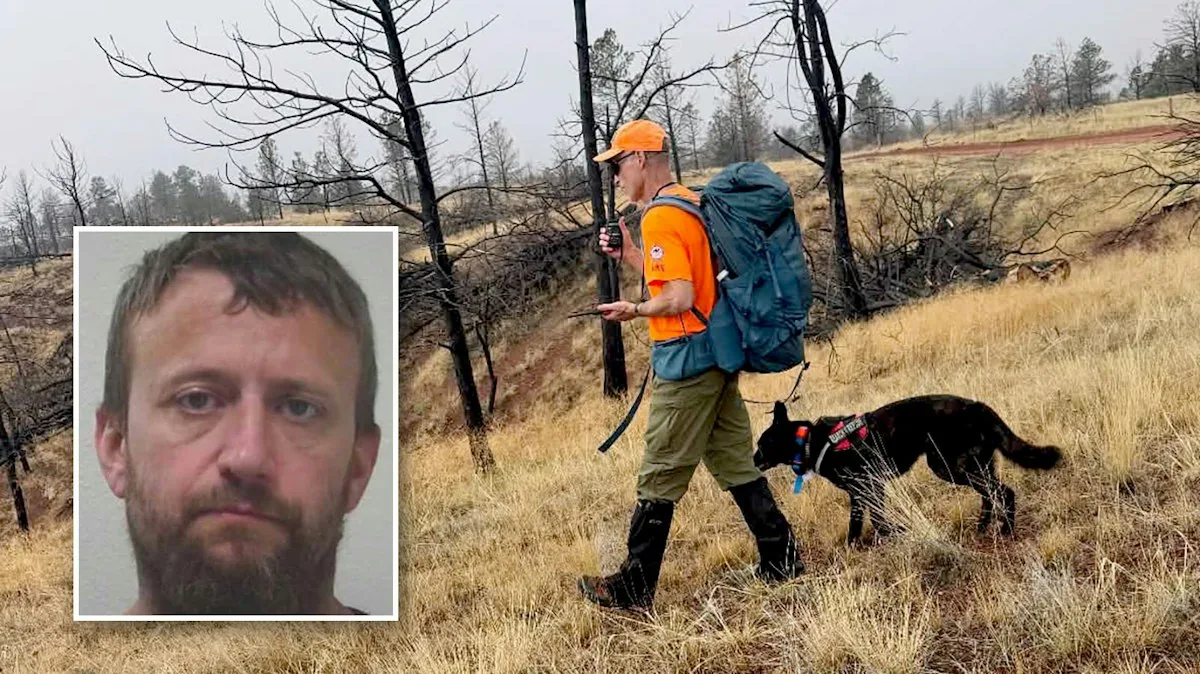
GILLETTE, WY — Searchers in northeastern Wyoming appear to have found the remains of Derek Schaff, a 43-year-old Gillette man who had been missing for nearly three months after his pickup and other belongings were found abandoned in the Weston Hills Recreational Area north of town.
The discovery came Saturday afternoon during a volunteer search effort that had drawn help from multiple states and relied heavily on canine teams. Searchers said the find shifted the operation from a rescue effort to a recovery, with authorities later saying they are confident the remains are Schaff’s while awaiting formal identification and DNA confirmation.
The Campbell County Sheriff’s Office said no obvious signs of foul play have been found, though the cause and manner of death remain pending. For Schaff’s family, the discovery brought a measure of closure after months of uncertainty.
A call of “official time” signaled the breakthrough
The moment came at 1:39 p.m. Saturday when John LaBrec of Canine Team Seven radioed in the phrase “official time,” the code used to indicate human remains had been located. On the other end of the communication, Travis Bateman sprang from his folding chair at incident command and rushed to the walkie-talkie.
Bateman and the other searchers were on a lunch break when the message came through. About a dozen volunteers crowded around as he logged coordinates and tried to pinpoint the location on a CalTopo map. The mood quickly shifted from routine field logistics to stunned silence as the group understood what the message meant.
By then, the search teams had spent weeks trying to narrow the area where Schaff might be found. The discovery was within roughly a half-mile of where his truck and belongings had been left behind, according to the account shared by those involved in the search.
WyoFind led a four-state effort to narrow the search area
Stacy Koester, founder and president of WyoFind Search, Rescue and Recovery, said her group had spent the previous two months working with the Campbell County Sheriff’s Office. The effort brought in searchers and K-9 teams from four states and grew into the largest operation Koester had organized for Schaff.
This was her fifth search tied to the missing man, and the biggest one yet, involving more than 20 volunteers and nine dog teams. Koester, who coordinated much of the effort around her full-time job, said the group had spent countless hours planning routes, arranging help and combing through difficult terrain.
On a search in August, volunteers found additional evidence that confirmed Schaff had been in the area and helped steer the teams toward the zone where they eventually made the discovery. The search was built from those clues, plus mapping work and field observations that steadily refined the likely location.
Steep ravines, deadfall and wet ground made recovery difficult
The terrain around the discovery site created major obstacles for everyone involved. Bateman, who heads Badlands Search and Rescue in Watford City, North Dakota, described steep slopes, drainages, thick vegetation, deadfall and post-fire timber that made movement slow and hazardous.
He said the weather added another layer of difficulty. Rain and mist the previous day had left the ground slick, and in some places the mud clung to boots so heavily that it felt like walking with plaster casts on.
Schaff’s body was found at the bottom of a ravine about 14 feet below the rim. Steep rock walls surrounded the area, forcing volunteers and officials to figure out a careful route for deputies and the coroner to reach the site and later recover the remains.
Bateman mapped a workable path, then drove as close as possible with Koester and a few others while additional volunteers marked the route with pink tape for arriving authorities. He said the rough country made the recovery a logistical challenge as much as a physical one.
Taz caught the scent and dropped into the ravine
LaBrec, a retired Teton County Sheriff’s deputy and veteran canine handler, said he and Megan Leisy were about to leave their assigned grid when Taz, his 9-year-old Dutch Shepherd, caught a breeze and surged down into the ravine barking. LaBrec followed and saw the remains.
He said he went down to make sure, but he could tell from above that the team had found Schaff. Taz has been his partner since she was a puppy, and LaBrec said the dog was on her second recovery search. He credited the find to the team’s persistence and to Koester’s coordination.
LaBrec said moments like that are difficult to describe because they bring both relief and grief. Searchers hope for closure for families, he said, and in this case they were in the right place at the right time.
Within a couple of hours, the sheriff’s office arrived and worked with Campbell County Coroner Paul Wallem to remove the remains. The weather was turning again as heavy clouds moved in over the hills, adding to the tense, solemn atmosphere at the site.
The Schaff family thanked volunteers while awaiting confirmation
The family learned of the discovery through a call from Sgt. Gary Sams of the Campbell County Sheriff’s Office on Saturday. Melissa Schaff, Derek’s sister-in-law, said the family continued to tell relatives on Monday that an autopsy was still pending and that formal identification had not yet been completed.
Melissa and her husband, Dominic Schaff, thanked Koester, the volunteers, the sheriff’s office and the broader community for supporting the search. She also said donations to a fundraiser helped cover travel costs for the searchers who came from out of state.
Melissa described Derek Schaff as a family-centered man, the youngest of four siblings and a father of two. She said he was hardworking, loved the outdoors, and was known for his humor, laughter and pranks among coworkers and family alike.
Donations will help future searches after Schaff case
Koester said the effort was possible only because volunteers gave their time to search for someone they had never met and because the sheriff’s office trusted WyoFind to help. She thanked the nine SARDUS dog teams from Montana, Utah, Colorado and Wyoming, along with volunteers from Carbon County West Search and Rescue, Badlands Search and Rescue and others who joined the effort.
She also said money left from the fundraiser will support future recovery work. That includes searches for Clifford “Russ” Haux, who vanished 23 years ago in the Red Desert, and efforts tied to barrels at the bottom of Fremont Lake that are believed to contain murder victims from 1980 after a confession by Gerald Uden.
For Koester, the Schaff search ended with emotion and exhaustion after months of work. She said bringing him home and giving the family closure was only possible because of the teamwork between search volunteers and law enforcement.